"If we are to teach real peace in this world, and if we are to carry on a real war against war, we shall have to begin with the children."

~Mahatma Gandhi

Sunday, January 2, 2011

Peace Education Workshop: Day 7

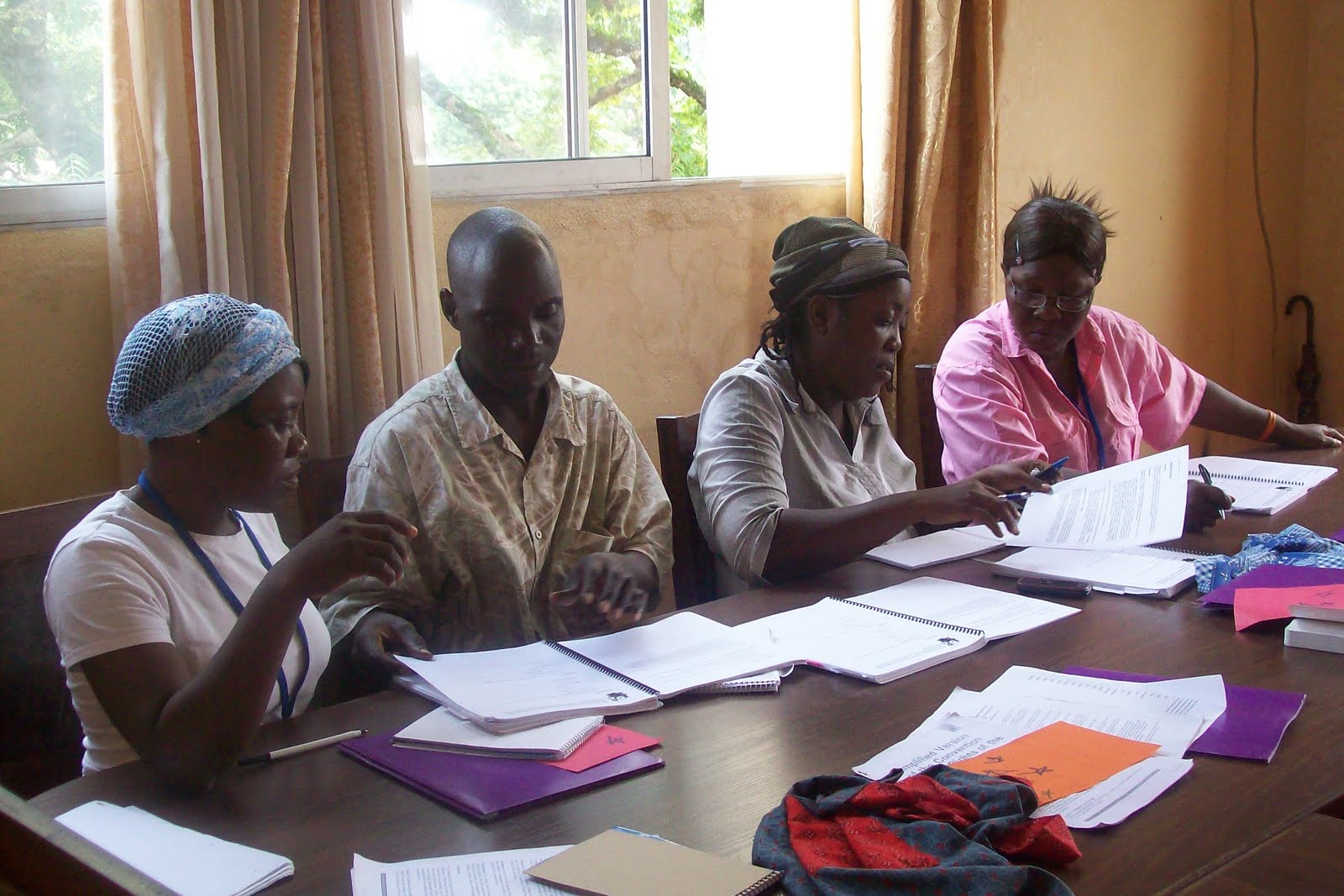
Day 7 of the Peace Education Workshop was spent utilizing the skills the participants learned the previous days. The participants presented their lessons using hands on activities and games. Each teacher had
a small group of "students" and were observed and given feedback on their lesson. The teachers and the students had a fun time getting into their roles and providing an opportunity for practice. This time was valuable to the participants' future use of the skills learned during the workshop.
Since Liberia's Independence day was soon approaching, the workshop was cut short a day earlier than planned. The rest of day 7 was spent bringing the workshop to a close and having an official closing ceremony. Participants, members of the Liberian Annual Conference, and local news reporters were invited to a celebration of learning and a call for equality. Jefferson B. Knight, the director of the Human Rights Monitor spoke, calling on government officials, as well as the United Methodist University to provide equal rights and equal opportunities to all people with disabilities throughout the country, especially equal educational rights. The participants also were given a small bag of classroom supplies, certificate of completion, and lunch.

Through it all, not only did the teachers and staff at Hope for the Deaf have an opportunity to learn and practice new skills, attention was given to a minority group of people striving to gain the support from their community and country, and two organizations came together to learn from each other and promote the rights of persons with disabilities.


Monday, November 8, 2010

Peace Education Workshop: Day 6


Day 6 of the workshop consisted of hands on games and activities, demonstrating how social skills and peace making skills can be taught through different learning modalities. For students who are deaf, or even most students, learning through movement, group discussion, and problem solving activities can be motivating, engaging, and a concrete way to learn abstract ideas and a great way to practice new skills.

Some of the games and ideas that were used throughout the workshop were taken from the book "Part Of The Group: Games That Increase Social Understanding" by M.W. Lou, E.S. Carlson, S.M. Gage, and N. Moser. These games focused on group work, communication, and leadership building. The most important part of the activities is the discussion after the completion of the activity. The students are allowed to complete the activity on their own (after some instruction) with some guidance from the teacher, the students learn how to solve problems on their own and how to effectively communicate to one another. The discussion allows the teacher to summarize what the students did and see if the students are able to recognize the learning points of the activity; providing an opportunity for reflection and discussion on relation of activity to real life.

The participants enjoyed "playing around" and were able to witness the potential of using hands on activities in their own classroom. The day also allowed the teachers to prepare short lessons using the activities to be taught the last day of the workshop.
___________________________________________

My time in Liberia in 2008 consisted of visiting various schools for the Deaf in Monrovia, visiting villages, completing workshops with teachers, and occasionally teaching the students at the Hope for the Deaf school. More often than teaching, I was able to just hang out with the students of the school. I enjoyed spending time with the younger students, reading children's' books that I had
brought-looking at the pictures and witnessing the excitement they had when they learned a new work or sign.

This time, in 2010, I went at a time when school was not in session. Therefore, I was not able to see most of the students that I grew to love two years before. While I did see a lot of the older students since some of them lived nearby and were able to travel without supervision, I was not able to see the younger students, including the ones pictured. I asked the Principal if there could be a day that all the younger students could come to the school so that I could see them once again. He obliged and was able to send out invitations to families to bring their children. It was a great afternoon. Some of the students had grown so much in the past two years. Though some were shy at the beginning, they quickly felt comfortable around me again and wanted me to watch them dance, jump rope, play football, and answer all the questions they had. For most of the students, this was a time to gather with other students who were deaf and to communicate in their natural language, something that does not always happen at home with their families.

The time was too short, and though the students and myself were not yet tired of chatting, they had to go. It was another sweet moment that I will forever cherish. I was recently surprised to receive many letters from the students, brought over from a friend who recently traveled to the country. It is the first correspondence that I have had with any of the students while in the States. Due to the cost, they do not have access to phones to text or to computers to send emails, they only means of communicating across distances for Deaf people in Liberia. Between 2008 and 2010, I had no contact with the students, so these letters were gratefully received. Hopefully I will be able to have more opportunities to communicate with the students in the future.

Monday, October 25, 2010

Peace Education Workshop: Day 5

The second day of the second week of the Peace Education Workshop focused on classroom management. The participants discussed the underlying causes of behavior problems within the classroom, reflecting on the role of the teacher and what the teacher can do to provide an appropriate atmosphere in his or her classroom. For the participants, this was beneficial; being able to take the excessive attention on what the student is doing, and instead looking at oneself to see what I am doing or not doing to support all my students.

While not all pressure was taken off the students, the teachers in the workshop were able to consider if their own knowledge of the content they were teaching, classroom environment, and lessons were supportive of a rich learning environment that let students think, create, and ask questions without fear. The participants recognized that it may not always be the students' fault, especially considering the previous days topic of Theory of Mind.

Discussion of motivation, discipline vs. punishment, and ways to encourage positive interaction with students were also included throughout the day.

____________________________________________________
As mentioned earlier, the weekend before the start of the second week of the workshop, I was able to travel to Ganta, which is in northern Liberia, near the Guinea border. We stayed on the United Methodist Ganta Mission Station, where are schools, vocational training programs, a church, and one of the largest hosp
itals in the country which also is home of a well established nursing school.

We were able to tour the grounds, talk to people working at the station, as well as others who come to the station for church, school, or hospital care. We lived a little rougher than we had been in Monrovia, with little electricity and no running water, but the women who cooked for us made wonderful bread.

You can see more pictures of the trip (as well as other pictures from the 3 weeks) here.

Monday, October 18, 2010

Peace Education Workshop: Day 4

The second week of the workshop focused on the development of Theory of Mind in students who are deaf. As discussed in an earlier post, Theory of Mind is the ability to have empathy for another person, understanding that other people may have different opinions than yourself, and being able to "walk in another person's shoes." This ability is delayed in students who are deaf, and is a skill that must be taught.

The fourth day was spent discussing why this occurs (through lack of incidental learning, communication barriers, etc.), exploring specific examples. The participants were able to see the need for teaching specific social skills in the classroom, especially ways to communicate and solve problems in a peaceful manner. This day laid the foundation for the remainder of the workshop-teaching social skills (including human rights issues) through games and hands on activities.

For further information on Theory of Mind, please see the earlier post.
_________________________________________________________

Over the weekend, I was able to travel to
Ganta, which is in the northern part of Liberia, close to the Guinea border. This was an excellent time to see more of the country. Though Liberia
is only about the size of Ohio, it took us about 12 hours to travel from Monrovia to Ganta. Between 2008 and 2010, there has been much improvement with roads. The road between
Monrovia and Kakata was amazing compared to what it was in 2008. Even with this development, there are still areas of Liberia that are not accessible with cars.


Friday, October 8, 2010

2nd Quest for Hope 5K Run/Walk


Just wanted to announce that we will be having our 2nd Annual Quest for Hope 5K Run/Walk (it's actually the 3rd year Quest UMC has sponsored it, with the first year going towards Nothing But Nets-hence it being called Quest for Nets) in Urbana, IL to benefit students in Liberia. Last year, we were able to raise $3,200 to go towards scholarships for students in Liberia. Half of that money went towards the students at Hope for the Deaf School, which provided them with the money to pay for student uniforms, school supplies, and also go towards providing salary for the teachers.

This year, we hope to raise even more, but we can't do it without runners or walkers. Go to www.questforhope5k.com to find out more information and ways to participate.

Friday, September 24, 2010

Peace Education Workshop: Day 4

On Day 4, it was the end of our first week of training. We discussed the possibility of peace without resorting to violence. We reviewed what we learned the past few days-reflecting on using international instruments to promote peace and equality.

With this in mind, the group brainstormed ways to work together-the Human Rights Monitor and the Hope for the Deaf school-to advocate for disability rights. Together, they decided to become more vocal and unified, urging the Liberian government and local organizations to provide services for
people with disabilities. They planned on utilizing local radio and newspaper outlets to generate awareness, as well as writing to government officials to encourage change.

It was a positive ending to the first week. Over the weekend, the participants looked forward to the next week of trainings, focusing on teaching peace through games and hands on activities.
_______________________________________________________


While in Liberia, it can be easy to concentrate on the "ugliness" of a war torn country--piles of refuse, shells of buildings, lack of services to parts of the country. It can be easy to overlook the beauty that it has--beautiful forests with great trees like the cotton tree shown, amazing views of the ocean and quiet beaches, the thankfulness of Liberia's people, even for the smallest of things.

It is never my intention to focus only on the negative, even though it may seem to overwhelm me at times; there is so much positive, so much determination and good will that radiates from Liberia that it is not hard to find hope. It is part of why I went back and will hopefully return to in the future.


Monday, September 6, 2010

Peace Education Workshop: Day 3

On the third day of the workshop, we discussed in depth the causes of conflict. The participants were able to make the connection between unmet basic needs and conflict, as well as how one handles conflict, which can either be in a positive way or a negative way. Though conflict (a disagreement) may be inevitable in life, it is the way one deals with conflict that will produce a positive or negative consequence. The participants also learned about various conflict resolution techniques through role plays and discussion.
The Human Rights Monitor led the dialogue on Liberia's own civil conflict,
connecting aspects to violations of basic human rights. Overall, the participants were able to see firsthand how to use role plays/discussion within a learning environment. The role plays allowed the participants to "step into someone else's shoes" to understand perspective and empathy-two vocabulary words for the day. It is hoped that the teachers at Hope for the Deaf school will use these skills and techniques within their own classroom in the coming year.

____________________________________________________________

One of the challenges during the workshop was a language barrier. While I am fluent in American Sign Language, and Liberian Sign Language is very similar, it was still difficult at times to bridge the gap between the two languages. This being my second trip to Liberia, as well as working with the staff at Hope for the Deaf, it did not take me as long to adjust my signing as last time--substituting American signs for Liberian. But extra time (as much as possible) was spent going over specific vocabulary and teaching new signs to the staff who were deaf, making sure they understood the material. Unfortunately, this time my stay was much shorter, causing our extra time to be squeezed. Fortunately, the staff was very patient and worked hard to learn the new language needed to teach peace.

Tuesday, August 31, 2010

Peace Education Workshop: Day 2

The second day of the workshop, the UMC Human Rights Monitor led the discussion about specific human rights declarations, as well as the relevance of the Liberian Constitution. Many documents were introduced and discussed in detail, such as the Universal Declaration of Human Rights, the UN Convention on the Rights of the Child, Convention on the Rights of Persons with Disabilities, Declaration on the Elimination of Violence Against Women, and the Liberian Constitution.

Participants worked together to understand the language of the various documents. They also were able to have an open conversation on how their own country followed through on these declarations and conventions, as well as addressed the obstacles within themselves and their community to addressing equality.

While these declarations and conventions are signed by the Liberian government, the participants felt the fulfillment of all rights for persons with disabilities is not being met.

This day brought much, somewhat difficult, information, but the consensus was that without having the knowledge of their own rights, they could not move forward as a country and as a people; cementing the fact that they must teach this information to their students.
____________________________________________________________


As I've said in earlier posts, one of the things I wanted to make sure I provided during the workshop was food. With the support of local churches, family, and friends, we were able to provide food in the morning and at midday. For two weeks, I knew that my friends in Liberia were eating more than one meal a day. This helped them to not only live more healthy during those
weeks, but also be able to work and pay attention throughout the workshop. Typically (and I'm sure it started again the day I left), Liberians only eat one meal of rice per day.


There were also leftovers enough to feed some of the students that helped us out, including one student who became my personal photographer for the trip, Mekeh. Mekeh enjoyed taking pictures of himself like this one.

Tuesday, August 24, 2010

Peace Education Workshop: Day 1


Day 1 of the Peace Education Workshop was spent focused on establishing ground rules and appropriate expectations of all participants, including the facilitators.

All staff from the Hope for the Deaf School and the Human Rights Monitor were in attendance, along with a parent of a student from the Hope School, two older students from the school, and a couple of community members interested in the rights of persons with disabilities.

Discussion the first day was centered around defining "rights," as well as different meanings of violence, and what a "culture of peace" entails. The first day created a foundation on which the rest of the workshop was established.

____________________________________________________________

That evening, several students from the Hope School stopped by the compound to hang out. The students enjoyed talking with the other teachers in the group-even though the teachers knew little sign. We spent hours talking and playing games, catching up on each others' lives. They still remembered how to play "slap-Jack," which I taught them two years ago. I taught them a new game this year, of which we played almost every day for the remainder of the trip.

Sunday, August 15, 2010

Teacher Training 2010

Unlike in 2008, this trip to Liberia, I went with an Illinois Great Rivers Conference teacher training group. There were 4 other teachers, plus the volunteer coordinator. While I conducted the Peace Education Workshop with the Hope for the Deaf School, the other teachers conducted a phonics workshop for teachers from various United Methodist schools in Monrovia. The teachers represented varying years of knowledge and expertise. Three of the teachers were experiencing Liberia for the first time.

The first day we spent visiting the UMC Conference office, meeting with Bishop Innis (pictured in the middle), and resting up from long travel.

I also was able to see many students and directors from the school again after
two years. It was a very happy day.

David showed me the new addition that was built onto the school, pictured below. Their hope is to have it become a central place for their vocational training classes. They would like to have computers available for computer classes, sewing machines for tailor classes, and equipment available for teaching hair braiding.


While they have the building (though it's not completely finished), they do not have the necessary equipment, including access to electricity. Their current building used for classes is becoming fuller-having had an increase of student enrollment within the past two years as well.

Future postings will highlight some of the successes they have had in the past couple of years, as well as some of the challenges they face currently and in the future.


Tuesday, August 3, 2010

To Liberia and Back


Well, we made it to Liberia safely, and returned safely as well. I had hoped to post a few times while were in Liberia, but unfortunately, we were not able to connect to the internet consistently. Therefore, I will be posting pictures and details about the trip and the workshop in the coming weeks.

Overall, the trip was a success. We were able to conduct the Peace Education Workshop, alongside the UMC Human Rights Monitor, over eight days. Participants were able to receive important materials, information, practice, and food throughout the workshop. In all, there were 20 participants, including teachers, human rights advocates, parents, students, and community members. While I hope that the participants learned many things, the one thing I am most excited about is the renewed commitment between the Human Rights Monitor and the Hope for the Deaf School to work together to advance the rights of persons with disabilities within their country. They realized that, together, they can make a greater impact and have a louder voice; through not only teaching their students about human rights, but also petitioning the community and the government to respect the rights of their students.

When the workshop was not in session, I personally was also able to do more traveling, to see more of the country and to witness the change since I was there in 2008.

Look forward to more pictures and stories of the Peace Education Project and Liberia 2010.

Wednesday, July 7, 2010

Days and Counting


As the departure date draws nearer (two days in fact, three days till arrival to Liberia), last minute errands for materials, quick emails between myself and my partners in Liberia, and checking and re-checking packing lists have been my priority. Questions have also come to mind.

Small ones like: Do I have everything? What will I take to read? Will I forget anything?

There have also been big ones.

Will the Peace Project be beneficial? Will the information be understood by the participants? Will it make a difference?

While I don't know the answers yet, I hope that my second-guessing is only temporary and unwarranted.

What I do know for sure is that the Peace Education Project for Hope for the Deaf could not have been possible without the prayers, words of encouragement, and financial support of friends and family. I am forever grateful, and appreciative of being a part of a community of people that believe in the cause I am passionate about; people who believe in education and peace for all.

Thank you all, and I will see you in Liberia.

Wednesday, June 23, 2010

Convention on the Rights of Persons with Disabilities


There are only 17 more days till we leave for Liberia. It is hard to believe it is so close. I have finished compiling the manual for the peace workshop, and am getting other last minute materials together.

While compiling the manuals, I included lots of information from different organizations that work towards peace. Like I said before, I have been getting ideas and information from the Hague Appeal for Peace. I have also used a lot of documents from the United Nations. One important document that I have included is the United Nations Convention on the Rights of Persons with Disabilities.

This convention was adopted by the UN in 2008. While I was in Liberia in 2008, I was able to participate in a march to the capital building in Monrovia to present a petition to have the convention ratified by the Liberian government. I was able to march alongside the students and staff at Hope for the Deaf School and show my support for all Liberians who have a disability. It was exciting to be a part of such a monumental demonstration, but there is still a long way to go. It currently is still not ratified by the Liberian government.

Even though it is not ratified, Liberians who have a disability now have an international document that states their rights, and such document provides them with the knowledge they need to advocate for themselves.

The Peace Education Project aims to provide the staff of Hope School the opportunity to learn about the Convention and their rights in their own language (Liberian Sign language), as well as with the skills to teach their students with developmentally appropriate games and activities about their rights and peace.

My hope is that this will allow their voice to be heard amongst the rebuilding of their country.

Sunday, May 23, 2010

New Sign Language Programs


Outside the capital, Monrovia, education in Liberia can be very limited. For persons who are deaf, education outside the city is non-existent. Deafness in Liberia is most commonly caused by natural or preventable causes-diseases or from the war. Families do not understand what is wrong with their child, thinking it is something that they must burden with alone. They do not have truthful answers, a support group, or a way to fully communicate with their child.


These boys from a rural village were all identified as having hearing problems (there were possibly more, including girls, but these children were there at the moment). Though they attended the local village school (more than 60 students with one teacher with 11th grade education), they did not have a language to learn with or to communicate.

There are children and families like these all around Liberia. The Hope for the Deaf director and staff have always had the goal to start programs in the rural villages, like the one in Monrovia. They're hope is to begin a sign language tutorial program, then expand to educational services. They have identified two villages, Kakata and Gbarnga, where there is parent interest to start a sign language program for their children.


Even without consistent financial funds to support the program, the Hope staff are dedicated to bringing education to the Deaf in rural Liberia. They understand the importance of having a language, and are passionate about giving a voice to Deaf Liberians. I am proud of the staff of Hope and so glad to be a part of an organization that is helping to rebuild their country in a positive way, one student at a time.

Friday, May 7, 2010

Hague Appeal for Peace


In 1999, civil society organizations from around the world gathered in the Netherlands to discuss what could be done to create a culture of peace among the nations of the world. Their hope was to lay the groundwork for instilling peace within the minds of men rather than violence and war. The conference led to the Hague Agenda for Peace and Justice in the 21st Century, as well as resources to promote educating towards a culture of peace. This led quite well into the United Nations' Decade for a Culture of Peace that was discussed in an earlier blog post.

It is the Peace Lessons from Around the World, compiled by the Hague, that serves as a valuable resource as I prepare for the Peace Education Project this summer. It will provide lesson ideas, as well as history of peace education and discussion of culture of violence and culture of peace.

For further information, please visit the Hague Appeal for Peace website.

Friday, April 30, 2010

Dates Set


Dates have been set for the Peace Education Project this summer.
Arrival: July 11th
Workshop Part 1: July 13-16
Workshop Part 2: July 20-23
Family & Community Day: TBA

Logistics are starting to come together, as well as the materials that we will be using. Look forward to information on topics that will be covered.

Peace

Sunday, April 18, 2010

Liberia, Child Soldiers & Peace


Recently, I found a couple of videos about a young Liberian who was a child soldier during the civil war. He became a refugee in Ghana, went through counseling and training, then returned to his home country. As in other countries, child soldiers were heavily used during Liberia's crisis. For youth who were involved in the war and do not receive rehabilitation, like Augustine, face isolation and torment from past experiences. While rehabilitation programs exist in the country, it may take years to reach all the youth that were affected.

I also created a video of my own.

The Peace Education Project aims to bring a piece of the rehabilitation process to Hope for the Deaf school, providing the students with language, knowledge, and a safe environment to have their voice heard so that they may participate in the rebuilding of their country.

Wednesday, April 7, 2010

Thank you!


It is great to see the support that continues to come in. I have officially reached my goal (and then some) for funds for the workshops specifically. I cannot describe how much I appreciate your willingness to become a part of the peace story in Liberia.

As much as it is important to have further training for the staff at Hope, it is also important for the school to have supplies and materials, and for the staff to receive income for their work. Since there is no public education services readily available for students with disabilities in Liberia, private schools serving persons with disabilities are found within religious organizations, as well as non-government organizations. This means that they most likely choose high fees for the students to attend, or run on very little to maintain an educational environment. The Hope for the Deaf School is technically under the umbrella of the Liberian Annual Conference of the United Methodist Church. The school has held the believe that education should be accessible for deaf students and has kept their fees low compared to other schools in Monrovia. They run on sporadic donations by generous people in and outside Liberia. Staff income and funds for materials happen by chance. Staff morale is typically low, and it is often difficult to come to work to teach everyday (especially if it costs more than a weeks pay to travel to work). It is through their determination and passion for education that they continue to work, though pay is little.

With this in mind, if you would like to give to the school for staff salary and materials, please continue to use the Chip In button or give through the UMC Advance. When I go, I will give the funds directly to the school.

If you would have any questions, please leave a comment.

Stay tuned for further development of the Peace Education Project.

Sunday, March 21, 2010

Peace Education Project Objectives

As planning has continued, it has been great to see the support that has been coming in for the Peace Education Project this summer. Thanks to all those who have learned about the project and have become a part of the grassroots effort to build a sustainable future for the youth of Liberia.
Peace Project Objectives

Monday, March 15, 2010

International Decade for a Culture of Peace

This year marks the last in the International Decade for a Culture of Peace organized and promoted by the United Nations and UNESCO. During the decade, numerous UN, government, and non-government organizations have developed programs and activities to promote a culture of peace. Peace is considered by the UN and researchers not only as the absence of violence, but the restructuring of culture to reflect human rights, social justice, respect for cultural differences, and education for all.

These aspects of peace must be taught, especially in areas where oppression, abuse, inequality, and war has occurred. In Liberia, these instances of violence occurred almost continually for 14 years, and some, especially inequality, still occur today. As students who grew up during war, and students who witness injustices, how do you express your feelings and frustrations in a constructive way? Or if you are Deaf in an unequal world, how do you know the options that could and should be available to you?

It is through the Human Rights Monitor and the staff at the Hope for the Deaf school that I plan to begin the process of teaching, promoting, and instilling in the lives of the students. Even though it is the last year in the Decade for a Culture of Peace, it is only the beginning for the students of Hope.


*In the photo above are children in a rural village who were known to be deaf. They do not know sign language, and have limited access to education.


Peace Education Project: If you would like to give donations to help provide materials and resources for the Peace Education Project this summer, please use the "Chip In" button on the side. 100% of the proceeds will go towards materials for the workshops for the teachers to use and keep for future reference.