"If we are to teach real peace in this world, and if we are to carry on a real war against war, we shall have to begin with the children."

~Mahatma Gandhi

Friday, October 8, 2010

2nd Quest for Hope 5K Run/Walk


Just wanted to announce that we will be having our 2nd Annual Quest for Hope 5K Run/Walk (it's actually the 3rd year Quest UMC has sponsored it, with the first year going towards Nothing But Nets-hence it being called Quest for Nets) in Urbana, IL to benefit students in Liberia. Last year, we were able to raise $3,200 to go towards scholarships for students in Liberia. Half of that money went towards the students at Hope for the Deaf School, which provided them with the money to pay for student uniforms, school supplies, and also go towards providing salary for the teachers.

This year, we hope to raise even more, but we can't do it without runners or walkers. Go to www.questforhope5k.com to find out more information and ways to participate.

Friday, September 24, 2010

Peace Education Workshop: Day 4

On Day 4, it was the end of our first week of training. We discussed the possibility of peace without resorting to violence. We reviewed what we learned the past few days-reflecting on using international instruments to promote peace and equality.

With this in mind, the group brainstormed ways to work together-the Human Rights Monitor and the Hope for the Deaf school-to advocate for disability rights. Together, they decided to become more vocal and unified, urging the Liberian government and local organizations to provide services for
people with disabilities. They planned on utilizing local radio and newspaper outlets to generate awareness, as well as writing to government officials to encourage change.

It was a positive ending to the first week. Over the weekend, the participants looked forward to the next week of trainings, focusing on teaching peace through games and hands on activities.
_______________________________________________________


While in Liberia, it can be easy to concentrate on the "ugliness" of a war torn country--piles of refuse, shells of buildings, lack of services to parts of the country. It can be easy to overlook the beauty that it has--beautiful forests with great trees like the cotton tree shown, amazing views of the ocean and quiet beaches, the thankfulness of Liberia's people, even for the smallest of things.

It is never my intention to focus only on the negative, even though it may seem to overwhelm me at times; there is so much positive, so much determination and good will that radiates from Liberia that it is not hard to find hope. It is part of why I went back and will hopefully return to in the future.


Monday, September 6, 2010

Peace Education Workshop: Day 3

On the third day of the workshop, we discussed in depth the causes of conflict. The participants were able to make the connection between unmet basic needs and conflict, as well as how one handles conflict, which can either be in a positive way or a negative way. Though conflict (a disagreement) may be inevitable in life, it is the way one deals with conflict that will produce a positive or negative consequence. The participants also learned about various conflict resolution techniques through role plays and discussion.
The Human Rights Monitor led the dialogue on Liberia's own civil conflict,
connecting aspects to violations of basic human rights. Overall, the participants were able to see firsthand how to use role plays/discussion within a learning environment. The role plays allowed the participants to "step into someone else's shoes" to understand perspective and empathy-two vocabulary words for the day. It is hoped that the teachers at Hope for the Deaf school will use these skills and techniques within their own classroom in the coming year.

____________________________________________________________

One of the challenges during the workshop was a language barrier. While I am fluent in American Sign Language, and Liberian Sign Language is very similar, it was still difficult at times to bridge the gap between the two languages. This being my second trip to Liberia, as well as working with the staff at Hope for the Deaf, it did not take me as long to adjust my signing as last time--substituting American signs for Liberian. But extra time (as much as possible) was spent going over specific vocabulary and teaching new signs to the staff who were deaf, making sure they understood the material. Unfortunately, this time my stay was much shorter, causing our extra time to be squeezed. Fortunately, the staff was very patient and worked hard to learn the new language needed to teach peace.

Tuesday, August 31, 2010

Peace Education Workshop: Day 2

The second day of the workshop, the UMC Human Rights Monitor led the discussion about specific human rights declarations, as well as the relevance of the Liberian Constitution. Many documents were introduced and discussed in detail, such as the Universal Declaration of Human Rights, the UN Convention on the Rights of the Child, Convention on the Rights of Persons with Disabilities, Declaration on the Elimination of Violence Against Women, and the Liberian Constitution.

Participants worked together to understand the language of the various documents. They also were able to have an open conversation on how their own country followed through on these declarations and conventions, as well as addressed the obstacles within themselves and their community to addressing equality.

While these declarations and conventions are signed by the Liberian government, the participants felt the fulfillment of all rights for persons with disabilities is not being met.

This day brought much, somewhat difficult, information, but the consensus was that without having the knowledge of their own rights, they could not move forward as a country and as a people; cementing the fact that they must teach this information to their students.
____________________________________________________________


As I've said in earlier posts, one of the things I wanted to make sure I provided during the workshop was food. With the support of local churches, family, and friends, we were able to provide food in the morning and at midday. For two weeks, I knew that my friends in Liberia were eating more than one meal a day. This helped them to not only live more healthy during those
weeks, but also be able to work and pay attention throughout the workshop. Typically (and I'm sure it started again the day I left), Liberians only eat one meal of rice per day.


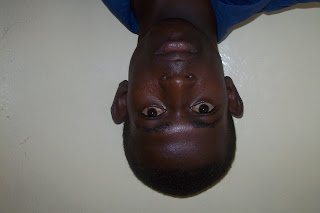
There were also leftovers enough to feed some of the students that helped us out, including one student who became my personal photographer for the trip, Mekeh. Mekeh enjoyed taking pictures of himself like this one.
Tuesday, August 24, 2010

Peace Education Workshop: Day 1


Day 1 of the Peace Education Workshop was spent focused on establishing ground rules and appropriate expectations of all participants, including the facilitators.

All staff from the Hope for the Deaf School and the Human Rights Monitor were in attendance, along with a parent of a student from the Hope School, two older students from the school, and a couple of community members interested in the rights of persons with disabilities.

Discussion the first day was centered around defining "rights," as well as different meanings of violence, and what a "culture of peace" entails. The first day created a foundation on which the rest of the workshop was established.

____________________________________________________________

That evening, several students from the Hope School stopped by the compound to hang out. The students enjoyed talking with the other teachers in the group-even though the teachers knew little sign. We spent hours talking and playing games, catching up on each others' lives. They still remembered how to play "slap-Jack," which I taught them two years ago. I taught them a new game this year, of which we played almost every day for the remainder of the trip.

Sunday, August 15, 2010

Teacher Training 2010

Unlike in 2008, this trip to Liberia, I went with an Illinois Great Rivers Conference teacher training group. There were 4 other teachers, plus the volunteer coordinator. While I conducted the Peace Education Workshop with the Hope for the Deaf School, the other teachers conducted a phonics workshop for teachers from various United Methodist schools in Monrovia. The teachers represented varying years of knowledge and expertise. Three of the teachers were experiencing Liberia for the first time.

The first day we spent visiting the UMC Conference office, meeting with Bishop Innis (pictured in the middle), and resting up from long travel.

I also was able to see many students and directors from the school again after
two years. It was a very happy day.

David showed me the new addition that was built onto the school, pictured below. Their hope is to have it become a central place for their vocational training classes. They would like to have computers available for computer classes, sewing machines for tailor classes, and equipment available for teaching hair braiding.


While they have the building (though it's not completely finished), they do not have the necessary equipment, including access to electricity. Their current building used for classes is becoming fuller-having had an increase of student enrollment within the past two years as well.

Future postings will highlight some of the successes they have had in the past couple of years, as well as some of the challenges they face currently and in the future.


Tuesday, August 3, 2010

To Liberia and Back


Well, we made it to Liberia safely, and returned safely as well. I had hoped to post a few times while were in Liberia, but unfortunately, we were not able to connect to the internet consistently. Therefore, I will be posting pictures and details about the trip and the workshop in the coming weeks.

Overall, the trip was a success. We were able to conduct the Peace Education Workshop, alongside the UMC Human Rights Monitor, over eight days. Participants were able to receive important materials, information, practice, and food throughout the workshop. In all, there were 20 participants, including teachers, human rights advocates, parents, students, and community members. While I hope that the participants learned many things, the one thing I am most excited about is the renewed commitment between the Human Rights Monitor and the Hope for the Deaf School to work together to advance the rights of persons with disabilities within their country. They realized that, together, they can make a greater impact and have a louder voice; through not only teaching their students about human rights, but also petitioning the community and the government to respect the rights of their students.

When the workshop was not in session, I personally was also able to do more traveling, to see more of the country and to witness the change since I was there in 2008.

Look forward to more pictures and stories of the Peace Education Project and Liberia 2010.